Episode 126
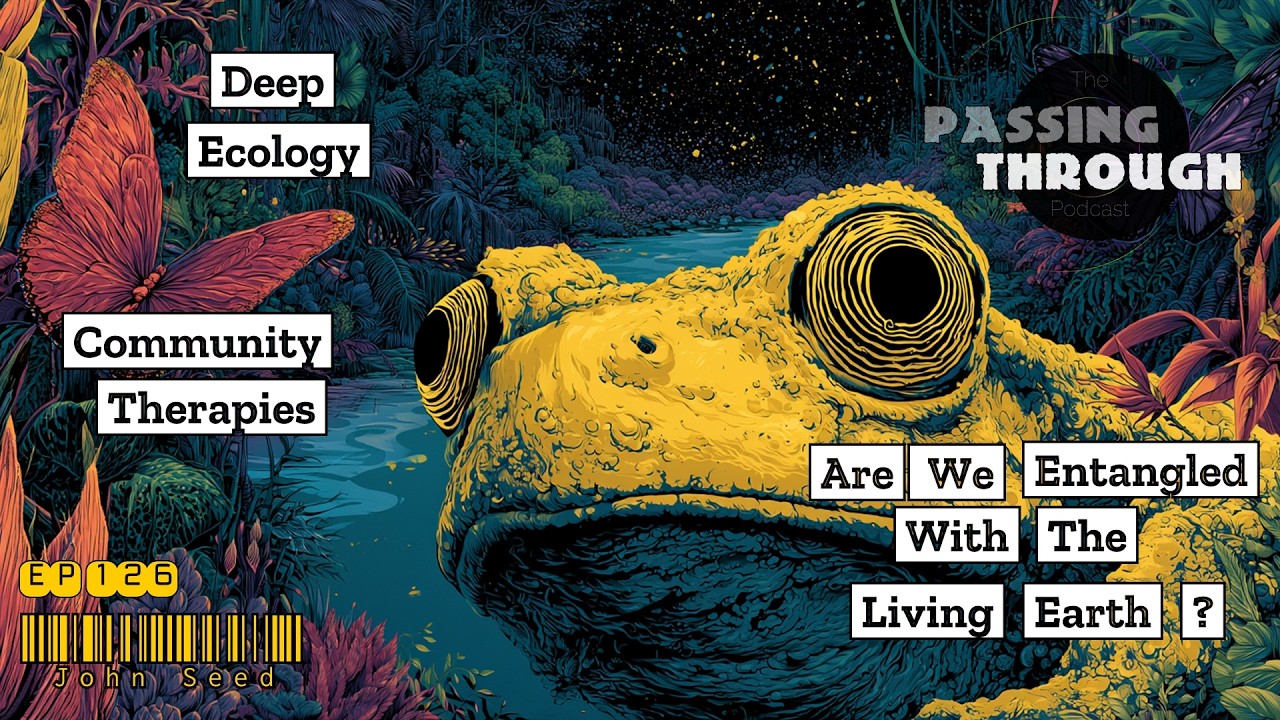
John Seed | Deep Ecology & Community Therapies | Are We Entangled With The Living Earth?
Listen
This week John Seed is Passing Through. A pioneering environmentalist, musician, activist and writer, John has played a formative role in shaping Deep Ecology globally. Beginning back in 1979 he began putting his life on the line to defend rainforests and would later found and direct The Rainforest Information Center to continue this important work.
Since then he’s initiated projects protecting rainforests in South America, Asia and the Pacific, providing sustainable development and working with indigenous inhabitants to protect their forests.
During his more than 40 year career John has worked alongside prominent figures such as Vandana Shiva, Starhawk, the late Ram Dass and Joanna Macy to name a few. In 1988 John, writing with Joanna Macy, Arne Naess and Pat Fleming, published their seminal deep ecology book Thinking Like A Mountain. In collaboration with Joanna Macy he created a ceremony aimed at reconnection called The Council of All Beings, which we’ll talk about in our conversation.
I speak with John about a landmark court case involving the Los Cedros rainforest in Ecuador. In a groundbreaking move for legal and environmental history, the MOTH (More Than Human) Life Collective is submitting a petition to Ecuador’s copyright office to recognize the Los Cedros cloud-forest as the co-creator of a song titled Song of the Cedars, composed in collaboration with musician Cosmo Sheldrake, writer Robert Macfarlane, field mycologist Giuliana Furci, and legal scholar César Rodríguez-Garavito. It will be the first legal attempt to recognize an ecosystem’s moral authorship in the co-creation of a work of art. This case aims to disrupt traditional anthropocentric copyright frameworks by granting creative rights to a non-human natural entity. This is the first known attempt in any jurisdiction to establish the 'moral authorship' of an ecosystem as a co-creator in an artistic work.
John is an absolute legend who’s dedicated his life to protecting animals, endangered species and rainforests, while writing, lecturing, facilitating workshops and campaigning & petitioning governments all over the world to protect ecologies.
It was a true honor to speak with John, and if you want to learn more about him and his work you can find him at johnseed.net, or https://www.rainforestinformationcentre.org/.
Links
- John's Website
- John's Links
- Rainforest Information Centre
- Los Cedros
- Song of the Cedars
- Thinking Like a Mountain
Transcript
You can't escape the reality of the fact that we are inextricably embedded, inextricably entangled with all of the forces of life on earth. And if we understood that not as an intellectual proposition, but as an experience of identity, then it wouldn't require any high moral stature to engage in correcting a lot of the things that are going on. It would merely be self-defense. You know, self-defense, self-interest isn't something that's difficult for us. You know, self-interest is easy for us. The problem is the self that we're interested in is a social fiction. It has no actual existence. Welcome to the Passing Through Podcast, a show dedicated to exploring those spaces, the moments not just within, but also between and around us. The cracks in the walls. The moments between the moments. I speak with thinkers, authors, artists, teachers, and everyday humans who have touched the edge of the ordinary and found something to bring back. I'm coming to you from an apartment in Poland at a few minutes to midnight. So this is a little bit unusual in terms of work hours for me. Why am I doing this at this hour? I don't know. I haven't been able to sleep well lately. Not because I'm drinking coffee or tea, but due to some unknown, mysterious reason, I'm coming to you close to the witching hour to talk about this week's guest. This week, John Seed is passing through. A pioneering environmentalist, musician, activist, and writer, John has played a formative role in shaping deep ecology globally. John has produced five albums of environmental songs and numerous films. Beginning back in 1979, he began putting his life on the line to defend rainforests, and would later found and direct the Rainforest Information Center to continue this important work. And since then, he's initiated projects protecting rainforests in South America, Asia, and the Pacific, providing sustainable development and working with indigenous inhabitants to protect their forests. During his more than 40-year career, John has worked alongside prominent figures such as Vandana Shiva, Starhawk, the late Ram Dass, and Joanna Macy, to name a few. In 1988, John, writing with Joanna Macy, Arnie Ness, and Pat Fleming, published their seminal deep ecology book, Thinking Like a Mountain. In collaboration with Joanna Macy, John created a ceremony aimed at reconnection called the Council of All Beings, which we'll talk about in our conversation. I speak with John about a lot of things. One thing of particular interest is a landmark court case involving the Los Cedros rainforest in Ecuador. This will be the first legal attempt to recognize an ecosystem's moral authorship in the co-creation of a work of art. This is a case which aims to disrupt traditional anthropocentric copyright frameworks by granting creative rights to a non-human natural entity. This is the first known attempt in any jurisdiction to establish the moral authorship of an ecosystem as a co-creator in a work. So this is a fun conversation for me. John is an absolute legend who has dedicated his life to protecting animals, endangered species, and rainforests while writing and lecturing and facilitating workshops and campaigning and petitioning governments all over the world to protect ecologies. It was a true honor to speak to John. And if you want to learn more about him and his work, you can find him at johnc.net or rainforestinformationcenter.org or in any of the other places that you might expect to find him like Facebook, Instagram, Substack. I'll have links to all of his socials and the other ways that you can find and connect with him in the show notes. As always, be good to one another. I'll talk to you next time. And let's get to it. Okay, John Seed, welcome to the Passing Through Podcast. It's an honor to sit down with you. Thank you. And you were one of the few guests who recognized that this podcast takes its name from a piece of music. So I wanted to begin with that theme and ask you maybe a more unusual starting question. Can a forest copyright its music? Well, we're about to find out because the forest of Los Cedros in Ecuador, which I helped to protect 40 years ago, has recently a piece of music that was written in that forest and which includes the sounds of birds and frogs and other animals from that forest. The musicians have petitioned the relevant authorities in Ecuador claiming that the forest should be the fourth copyright holder alongside the three musicians. And whether this will be accepted at this time or not remains to be seen. But it follows hard upon the precedent that was set by the same forest three or four years ago after, in 2017, a corrupt decision by a politician later jailed for corruption on another matter, allowed multinational miners to set up concessions within Los Cedros and hundreds of thousands of hectares of the best forest in Ecuador. And we pursued the court case over many years that we won in the lower court and then lost on appeal. But eventually it ended up in the highest court of the land, which was the constitutional court of Ecuador. And there, our defense rested upon a clause in the Ecuadorian constitution, which had never been tested in court before, where Ecuador is the first country in the world that includes the rights of nature as part of their constitution. And that's what we used in our defense. And the court, I guess, seeing the opportunity to create this precedent, judged in our favor. So the cornerstone mining resources from Canada was ejected from the reserve. And the precedent that was set at that time has been used to protect other natural areas in Ecuador and has also, I think, having some impact as a precedent in other parts of the world. So I think it's also a precedent for this move by the musicians, one of whom, Cosmo Sheldrake, is on the board of the Los Cedros reserve with me and is clearly pushing that boundary a little bit further. Yeah, that's such a beautiful story because the rights of nature enshrined in a constitution should be ubiquitous, I would think. It should be everywhere. Unfortunately, it isn't. It's a very hard-fought kind of victory. So that's amazing that you helped to gain those natural rights there and then expanding it now where the kind of sonic signature of a given ecology can also be protected. And it's just a very psychedelic, far-out, cool concept that I was really excited to see in this kind of groundbreaking case. Yeah, well, I mean, a hundred years ago, I think human rights was in the same position that the rights of nature are in now, you know, where every progressive move that's ever happened started out as an idea that probably seemed ridiculous given the paradigm of the time, but was eventually through many hard-fought battles just becomes common sense. Yeah. Yeah. Yeah. So fingers crossed that there's some new precedents set, but I wanted to take a step back a little bit and talk about something that you wrote recently because it can lead us into deep ecology, which is something you've been working in for decades. So I just want to give listeners some context. You had written, the central insight of deep ecology is beautifully simple. The self is wider than we have been taught. And can you explain what deep ecology is and what you mean about the self here in this context? Well, deep ecology is a term that was coined by the late Arnie Ness, professor of philosophy at Oslo University, who claimed that underlying all of the symptoms of the environmental crisis, we find the illusion of separation between human beings and the rest of the natural world. And this illusion of separation is one way of framing it is that it's a case of mistaken identity, that we just don't understand who we are. So illusion of separation, maybe it sounds a bit kind of mystical or woo-woo, but to understand exactly what he meant without a shadow of a doubt, all that you have to do is hold your breath for about five minutes while you think about it. And then you recognize, of course, that it doesn't matter what we think about it. The reality is we are inextricably embedded in nature. The air is part of our existence. The air is part of our self. We have no self without the air. Joanna Macy, who was another teacher of mine, we wrote a book together in 1988 called Thinking Like a Mountain. And in that, we wrote something called a Gaia meditation. It starts, what are you? What am I? Intersecting cycles of earth, water, air, and fire. That's what you are. That's what I am. And then, you know, unpacking each of those, explaining what's meant by each of those. And so, you know, we've been, you know, we've been hoodwinked by Judeo-Christian tradition and all kinds of other traditions into imagining that we're somebody else, but it doesn't work. You can't escape the reality of the fact that we are inextricably embedded, inextricably entangled with all of the forces of life on earth. And if we understood that not as an intellectual proposition, but as an experience of identity, then it wouldn't require any high moral stature to engage in correcting a lot of the things that are going on. It would merely be self-defense. You know, self-defense, self-interest isn't something that's difficult for us. You know, self-interest is easy for us. The problem is the self that we're interested in is a social fiction. It has no actual existence, you know. And it's amazing that people are prepared to die by the millions in defense of one social fiction or another. And yet, when somebody disobeys and puts themselves in danger of incarceration or a physical danger in defense of the earth, people are shocked. As if there's something strange about that, you know. And yet the earth is where all the countries and the religions and the ideals and all of the things that people struggle and fight for, they're all born out of the earth. Anyway, that's my version of deep ecology. When I hear that, it sounds a lot like ancient animist ideas of relationally entangled selves. And I wonder, what's the difference between an animist cosmology and deep ecology? Because they sound very similar to me. Yeah, I don't think that there's any difference at all. I mean, Arnie Ness acknowledged this. But I guess one difference is that animist traditions that still survive, not ones that are being recreated, but longstanding indigenous animist traditions, don't necessarily appreciate having their ceremonies borrowed by New Age philosophers. And so the difference is that deep ecology is attempting, I think, to start from recreating ourselves from right where we are now. You know, not really borrowing from the past, acknowledging, of course, that it's not like this is anything new. This is perennial. You know, this is just like every spring the leaves come out. And what did Cat Stevens say? Blackbird is singing like the first bird. So the philosophy is utterly new and unprecedented. And it's completely the same as what people have understood for, you know, half a million years, because it's true. And so you don't have to borrow it from anyone else. You just have to look out into the world and figure out what's true. And this, I believe, is what you find. Two things came to me as you were speaking there. The first is porosity. This idea that the self isn't this isolated, separated, invulnerable, impenetrable thing. It's fluid and things come out and go in and boundary is fuzzy. You said that we are as much air as we are us. And if we are as much air, then we are as much ocean. We are as much plants. We are the sun. Because all of these things work in a relationship to produce this process that is our existence. So this is really interesting to me. And I wonder what your thoughts are on that stuff. Do concepts of separation, the self as a completely isolated thing, really prevent us from seeing how interconnected everything is? Well, I'm not sure if it's the concept that prevents it so much as the experience that we have of ourselves. Because we're caught in a paradigm. And unless we examine it very closely, we're social beings. And we're surrounded by people who are all sharing a common delusion. And it's very, very difficult to extract oneself. You know, Arnie Ness called for community therapies to heal the illusion of separation. Because it's not something that an individual can easily accomplish. But a group of people working together, willing to embrace this different paradigm through certain ceremonies, we can move away from that and into a new paradigm. And it's a bit like a psychedelic where when you're suddenly there, you can't imagine that you missed it a moment ago. How could you possibly have not seen that this is how things are, that this is the case? And it's impossible to imagine that it could ever disappear, but it always does, you know? And so how to create, how to recreate a culture of connection is just like a question that refuses to go away. You know, deep ecology, according to Arnie Ness, his definition of deep ecology was asking deeper questions. And I love that because it's like, it's not about finding an answer. That when you find an answer, the answer is always contingent. The answer is always ready to be superseded at some future time. And the purpose of the answer is to deepen the question, to deepen the inquiry, and to let yourself continue to be bothered by the questions that matter. And, you know, what you were saying reminded me that it's not just animism, but certain strains of Buddhism. And, you know, all spiritual traditions have outliers who find themselves in a position that's indistinguishable from deep ecology. In Christianity, it might be St. Francis, you know? In Buddhism, it's Thich Nhat Hanh. Thank you for that. And I was thinking of Thich Nhat Hanh as you were speaking as well. And before we move deeper, because I want to touch on what you just mentioned about community therapies and ceremony and ritual. But before we do that, I wanted to ask one question, because it seems that there's been a sort of forgetting. In ancient times, we knew this stuff. Now, certain people through deep ecology, eco-psychology, where people are seeing the self as ecological, it's becoming real again. We're remembering. But I wonder, from your perspective, what caused the forgetting to begin with? Good question. I don't know. Depends how far back you want to go. Perhaps we could talk about the fall into agriculture and our relationship with animals changing when, instead of being equals, all of us have to eat each other. And we can do so in a respectful way. All of a sudden, we're standing behind this ox in the heat, surrounded by flies beating it with a stick. You know, like, I mean, agriculture and, you know, our ability to create surplus. I don't know if you know the song, The Burning Times by Charlie Murphy. But I guess it's like Starhawk's story of the persecution of the witches, the witch hunting, and the way that the nature religions were deliberately driven underground because they stood against the authority of the patriarchal church. Or maybe it's capitalism or maybe it's colonialism or maybe it's colonialism or all of these things. I really like Vanessa Andriotti. I don't know if you know her work, but I really like it. Yes, I love her. It's all just entangled together. And, you know, you can choose a particular thread and shine a light on it. But, you know, it's just all a big tangle of everything's causing everything. Well said. And actually, it's funny that you mentioned Vanessa, because I have a quote here by her that could lead us in the direction that we want to go. So amazing that she just came up. She said something that I think is very aligned with your thinking. She said that collective pain demands collective hearts, spaces where we can come together to witness, hold, and metabolize the weight of what modernity has made unspeakable. And I wonder for you, does that evoke these feelings of community therapies and coming together in groups? And if so, maybe we could talk about what community therapies are. Well, absolutely it does. And I'm not sure where you found that particular quote, but if I missed it while I was reading one of her three books, I'm surprised because you couldn't find a better description of the work of Joanna Macy, my next teacher after Arnie Ness. Arnie Ness gave me the philosophy and the idea that we needed community therapies. And Joanna Macy added the psycho-spiritual technology that allows the ideas of deep ecology to turn into ecological identity, to turn into community therapies that change us at a much more profound level than just the level of ideas. Arnie Ness said ecological ideas won't save us. What we need is ecological identity, ecological self. And so Joanna Macy's work, which she went on to call The Work That Reconnects, it started out in what she called Despair and Empowerment. And then it became The Work That Reconnects, where the Despair and Empowerment piece was the second station in The Work That Reconnects, which she called then Honouring Our Pain for the World. And it's the crucial ceremony without which the remainder of that work, which we call Seeing with New and Ancient Eyes. It's hollow and it's inauthentic because what has to happen first is that the group of people that's surrendering to this has to spend a time immersing ourselves in the deepest feelings of anguish and rage and terror and despair and listening to each other, learning how to create a safe container so that this can be done without any fear, without any damage to anybody. But then to just listen to the whole cacophony of agony that lies in every heart when we open ourselves to what's happening to our world. And it sounds like Vanessa Andriotti totally nailed it in that quote. And do you happen to know where you found that quote? Because I'd like to find it myself. It was either in Hospicing Modernity or Outgrowing Modernity. I could find out and send you the... Oh, well, just send me the actual words. And yeah, if you find out where it's from, I'd like that. I wonder why is it... I guess there's two parts to what you just said. I wonder why it's necessary to do this as a group. Why do we have to come together? Because I do group work. You could think of them as grief circles, but it's not exclusively grief, but mostly grief comes up. Because like you said, in everybody's heart, these things are there. And I've wondered why there's so much more healing and so much more potency when a group of people come together to talk about these things and witness one another and hold each other. And I wonder what it is. I would guess that these therapies couldn't happen with a therapist or alone in meditation, right? There's something about the group. And what is that? Well, I don't know that they couldn't happen, but I know that my work has always been around working with a group, partly because it means you can have 35 people have the experience rather than just one, you know. But I mean, this is pure conjecture. But I guess the way that my answer to that question is that these feelings which have been suppressed and denigrated by our culture, and we've been taught to fear these feelings, and we've been taught to hide these feelings from each other, so that when we get together in this ceremony, people are stunned because they've never in their life been in this situation where one person after another is speaking the truth about the most painful, terrifying, and raging subject with full force of feeling being invited and being present. That these feelings are an important part of our intelligence. That if we look back on 4,000 million years of successful evolution, we can say without a shadow of doubt that every single one of our ancestors was intelligent enough to reach the age of reproducing itself before it was consumed, without exception. And 99.999999999% of that intelligence preceded cognition. So what we call feelings is what remains in us of the ancient intelligence which allowed our ancestors, human and pre-human, to know what was dangerous and what was safe, and to make good decisions to stay alive, to know when to run, when to fight, when to freeze. You know, call it instinct, call it intuition, doesn't matter what you call it. This intelligence is vital. And it's not that I'm not denigrating cognition. It's very beautiful. But in the absence of the passion that the feelings bring, the cognition is sterile. Everyone feels paralyzed. Everyone feels helpless, hopeless. What can one person do? It's all too late, et cetera, et cetera, et cetera, until the passions are unleashed. And then it's a different story. So in terms of why it has to be done in community, I guess my conjecture is that I start from the fact that natural selection has to be working on a community level as well as on an individual level. It doesn't matter how fit an individual is. Unless they happen to be part of a community that's fit, they don't survive. No one, no individual, no matter how fit, can survive in the jungle, you know, in natural selection world without a community. And so we imagine a herd of pre-human, you know, descended from the forest and grazing, you know, hunting, gathering out. And one of them looks up and notices a predator and has a choice to either sneak slowly away so that when the predator charges, they're not in the line of fire and increase their personal chance of survival. Or to scream out immediately and warn everyone so that everyone runs like hell, perhaps decreasing their personal chance, but increasing the chance of that community. And that every, let us say 10,000 years or so, there's environmental pressure, climatic pressure, I don't know what. There's pressure. And in the same way as with individuals, there may be a thousand communities in Africa and 950 of them perish under the pressure. And the 50 that survive, it's not because they have the fittest individuals, but because they have the fittest social cohesion. They know how to look after each other. They know how to work together. They know how to look to have each other's back and to care for each other when times are tough. And that that is selected for again and again and again. And so when we get together in community and do this work, there's a tremendous feeling of coming home. You know, that although it's not something that we've ever experienced in our life, the most common statement in the sharing circle on the Sunday morning after, you know, spending 12 hours together on the Saturday doing this kind of work, people are just like, it was so familiar. Yeah. Thanks for that, John. And we've spoken about the community aspect of it. But I also wonder about the ritual container aspect of it, because there's something mystical, magical, ancient about people coming together and sitting in a circle and building a kind of energetic container where, like you said, all feelings are welcome, especially the ones that are kind of exiled and cast aside. And you've written about ritual, you've written about ceremony, and you wrote something that I really liked that said, ritual facilitates interaction between mind within the skull and mind outside the skull and the environment. And I wonder if you could talk a bit about that and what ritual is doing when we come together with these community therapies. I'm not getting anything right now. There may have been, you know, other times when I could have had a good answer for that. But at the moment, I can only say, it's just how it is. That's just the kind of people that we are, that when we look at cultures, for example, every single culture has a creation story. There's no culture that doesn't have a creation story. And all of these stories are very beautiful, and they're all very different. And, you know, there's just certain things that human beings do. Or maybe it is there's certain things that surviving human beings do. It may be that when times got tough, those that happened to have developed certain kinds of social forms were the ones that made it through, you know. And it's not, you know, afterwards we can have theories about what it is about those social forms. And maybe that's true or maybe it isn't. But I think that the actual emerging of those forms preceded, they didn't, they weren't constructed on the basis of people's ideas. You know, they were constructed by natural selection because they worked, because they kept people alive in community. They kept communities alive when times were tough. And when other communities were dropping like flies, we made it through. And all of the others that made it through, all of us had something in common. And I would say that ritual and ceremony is a name that we give to something that every group that made it through had in common. Hmm. And I wonder to help listeners if we could describe one or two of these. Because I know there's the Council of All Beings and there's the Cosmic Walk. Because people might hear, okay, community therapy, ceremony. It might be vague for some people. Could we maybe give them a little sense of what these things are so they can go, oh, okay, I see what they're talking about now. Maybe I'll give a brief description of the two that you mentioned. Because they're two that my last workshop two weeks ago, they were both included. And my next workshop in two weeks' time, they'll be included again. So the Council of All Beings was the first of the experiential deep ecology processes. That was designed by Joanna Macy and myself in October 1985, the month that we met. And we immediately hit it off and started designing Arnie Ness's community therapies together. And this was the first of them. So in the Council of All Beings, each of us finds an ally in the non-human world, a plant, an animal, a feature of the landscape, anything in the universe except for a human. That's the way I do the Council of All Beings. If you read Thinking Like a Mountain, which Joanna and I wrote with Arnie Ness and Pat Fleming in 1988, you'll see that the Council of All Beings described there includes humans. So there's no correct way to do it. But at the moment, I'm just sick of humans. They talk all the time. I want to hear from everybody else. You know, so my Council of All Beings, no humans. There's a ceremony to connect with an ally. People are encouraged to wait to be chosen by their ally rather than choosing. And then, you know, just sit with the discomfort of waiting for something to happen while your mind's going, oh, this is all bullshit. You know, nothing's going to choose me. And yeah, but just wait and wait and see what happens. And if nothing chooses you, that's fine. You can just choose anything. And then you make a mask to represent that ally. And then we walk through a ceremonial portal and enter the Council of All Beings, where we are invited to speak in the first person as our ally, become a voice or another voice than our own. You don't have to believe anything. You don't have to believe that this is really happening. You can think of it as an exercise in moral imagination. You can think of it any way you like, but just play. And invariably, everyone hears things that they've never heard before that are stunning, you know. And so we don't know why, but it all, and we, you know, like you can have theories then, but always we hear these amazing things that, you know, shock us, things that don't appear in any other conversation. And so I might add, in my introduction, I mentioned the fact that only a couple of years after meeting Joanna, I had the privilege to be a witness to a ceremony being conducted by some Hopi indigenous in the southwest of the United States, just a handful of outsiders like me and everybody else was from the community participating in the ceremony. And to my amazement, I saw that they were doing the Council of All Beings, which I thought Joanna Macy and I had invented the other day, but which they assured me they'd been doing for 10,000 years without a break. And so it's again, that this is perennial, that this is something, you know, yes, we did invented, but we invented it again, it's been invented 10,000 times and, you know, ours was the 10,001st, you know, we didn't know that, but that's probably how it is. So anyway, that's the Council of All Beings. And then the Cosmic Walk, so both the Council of All Beings and the Cosmic Walk are part of the station of the work that reconnects that we call seeing with new and ancient eyes. And I would never these days facilitate these in the absence of having first done the Honouring Our Pain for the World. And it's only in order to be eligible to celebrate in the way that these ceremonies allow, you have to have faced the bad news in public beforehand. So Saturday afternoon, we'll often do the Council of All Beings. It's Saturday Night, the Cosmic Walk. So the Cosmic Walk is based on the work of the late Father Thomas Berry, who was the, I guess, the leading progressive Catholic theologian of the second half of the 20th century. And he was late in his life. He had an epiphany where he realized that he was no longer a theologian, but had become a geologian. And his attention turned from the creation myth that he had represented all of his life from the Old Testament and the New Testament, Adel and Eve and that whole story. And he saw that this was just one of 10,000 stories that humans tell, you know, when the kids ask, where do we come from? You know, everyone's got to have a story. And he saw that these stories were very beautiful, but saw that they were at war with each other, that not just that you got a story and I got a story, but that I've got the true story, which makes you a heathen or a pagan or someone that I'm going to kill unless you change your mind. And so not just the Catholic versus the Muslim, but the Catholic versus the Protestant and the Sunni versus the Shia. And Thomas said, it's too late for all that. We need a story that's going to unite human beings rather than separate them, but that will give that numinous spiritual sense that a creation myth does. And he proposed that the story revealed by empiricism, the story revealed by our telescopes and microscopes, by cosmology and the study of evolution and so on, that correctly told, this could be the creation myth of our age. But he said, we can't leave it to the scientists to tell this story. We need the poets and the artists and the musicians and the mystics. And one of those who responded to Thomas was his colleague, Sister Miriam Therese McGillis, a Catholic nun from community in New Jersey called Genesis Farm. She created the Cosmic Walk. So the Cosmic Walk, I carry with me from workshop to workshop a 50-meter ball of hemp. And there are 23 beads appropriately placed around the hemp so that when it's laid down on the floor in a spiral, it represents the 13.7 billion year story of the cosmos since the Big Bang, or as Thomas Berry calls it, the Great Flaring Forth. And each of these beads represents a story in the emerging story of the universe, because the universe is just one unpredictable emerging property after the other, just pure creativity every step of the way. The very periodic table of elements was itself evolved, that when we take the light, when we focus our instruments back through time, because light travels at a certain speed, we can focus our instruments on our closest neighboring star, Alpha Centauri, and we're seeing light that left Alpha Centauri four and a half years ago, because that's how long it took the light to reach our telescope. If we focus on the supermassive black hole at the center of the Milky Way galaxy that holds the Sun and Alpha Centauri and 200 billion stars in perpetual gravitational embrace, if we focus there, we're seeing light that left 30,000 years ago. Our galaxy is 100,000 light years across. So as our telescopes go further and further out into space, they're seeing further and further back into time. And now, we can see the very beginning. If we focus any further than that, no light. But if we focus 13.7 billion years, we see the light. And then when we run that light through a prism, and the spectrum reveals the elements that were present where that light was generated, we see that at the beginning, there was nothing but hydrogen and helium. No other elements existed. And all of the other elements that compose our world, that compose our bodies, emerged in the course of the universe, emerging in the same way that life evolved. So the cosmos itself evolved in that way. And so we go around the spiral next to each of the beads that represents a story in the spiral. There's a tea light candle. And so slowly, a spiral of flame emerges as we ceremonially praise this extraordinary emerging story of the universe. And meanwhile, we're singing a chant written by Theo Simon from the world's greatest environmental band called Seize the Day. And it's a chant called Child of the Universe. The chorus goes, I am as old as the universe. I've been here before and I'll be here again. I am a child of the universe, part of all women, part of all men. And as with many rituals and ceremonies, chanting and drumming and community and all of these things creates a change in consciousness. And all people's recognized this. It's really not, there's nothing unusual about it at all, but it's a bit unusual in our culture where we've tended to dismiss these things as mumbo jumbo or woo woo or empty ritual or something like that. But it is so intimate and it is so compelling and it is so absolutely authentic when you experience it that all those doubts just vanish because you just, it's like a psychedelic. You cannot doubt. You cannot doubt that this is happening. Doubt is impossible. This is how it is. You know, it goes a bit like that. You know, psychedelics are a fascinating thing to me as well that they've always been. I wonder, has this work that you do, has it ever been married with psychedelics? Have you ever tried to do these things with a group that's like psychedelic assisted or to kind of deepen that? Not so much that, but I mean, there have definitely been people who, um, I have, you know, I haven't, if anybody ever asks me, I say, no, don't do psychedelics because, and, uh, don't smoke dope. You know, uh, don't change your consciousness because something is going to happen by itself and you don't want to add any confusing, you know, like you can smoke your dope tomorrow. You know, like it's, I'm not saying don't do it. I'm just saying like, allow yourself to have this experience because you won't really understand what happened if you add this kind of extraneous, um, molecule. I don't know. And, um, there's no doubt that the, the, that people report experiences, which, you know, if you didn't understand, if, if you didn't know the context that they were reporting, you might well think, oh, wow, that guy's tripping. Do you know that, that it's not, it's not dissimilar. The kind of experiences that people sometimes have just the same way as in breath work or, you know, like these things overlap with each other in all kinds of ways. And I would say also that if it weren't for psychedelics, I'd probably still be working for IBM, you know, that, um, none of this would, I mean, you know, it could well have emerged through somebody else, but none of the things that emerged through me would probably have had a chance to do so because, uh, you know, they were just without a doubt part of, uh, my, um, waking up. Hmm. Yeah. I, I'm curious to pursue that a little bit, maybe if you want to talk about that, because I, I've heard someone describe psychedelics and especially the natural ones like psilocybin and I mean, I guess technically they're all natural, right? They're just, um, synthesized. They come from the elements. We're not making things out of nothing, but, uh, I've heard of them described as ecodelics because they have a tendency or they have the possibility to connect you more deeply to your ecology and you understand your place within it in a way that starts to dissolve and erode this sense of separation that we spoke about at the beginning of our conversation. And I wonder if your experience was similar or if you have a story to share, maybe an insight that came to you that kind of brought you to where you are. Yeah. I mean, I agree with you, but I don't have any story to share because wherever that first psychedelic took me, there's no way that the mind could, the mind was left behind, you know, like there was, there's no memory. There's nothing, it just, uh, I woke up, my life changed. I was different. I left my job. I left my unhappy marriage. I left my paintings and my records and my apartment and everything and, uh, and hit the road, uh, and never looked back. And that was not an unusual story back in the early 1970s. Well, you know, in the United States, it was a few years before that, but I was in London and the early 1970s was a bit like that. But, uh, I would say that one of the things that is often revealed by psychedelics is that everything's alive, that everything's conscious, that consciousness is ubiquitous and that we're connected to all of these other conscious beings. Their consciousness is different than ours, but, uh, there's just this feeling that they want to help, if, if we're interested, they'll help us to come back into alignment with what everything else is aligned with. Do you know that when I look at the cosmos from the subatomic to the intergalactic, there is this, uh, sense of nested holes, holes within holes, within holes, within holes, and tremendous order? You know, I think about everywhere, on every level this is so, with the exception of the human personality and the creations of the human personality, the relationships and the institutions that that personality creates. But if you look at the human body, you know, it's like two cells, four cells, eight, sixteen, thirty, two, sixty, four, hundred and twenty-eight. At a certain point, one cell starts heading off in this direction to become a liver, another cell wanders off to become a brain. They've got the same DNA, they're just expressing it differently. And they're not communicating with each other, you know, they're not going, hey, I'm going to be, you know, they're just following orders. Everything's just doing what it naturally does. And, um, I get the feeling psychedelics and deep ecology both give me a sense that we could surrender so that the human personality could once again find its way to being nested within the whole, you know, nested within these wider reciprocities that it doesn't have to be thinking, you know, and so deep ecology, the illusion of separation is the result, according to Arnie Ness, of anthropocentrism or human-centeredness, the arrogance of thinking that human beings are the center of everything. The crown of creation, the measure of all being, um, the only thing that has intrinsic value, everything else can only have instrumental value. If you study economics, you'll find that human beings create value. Nothing has any value until human beings add their labor and intelligence to it. All that bullshit so, uh, so, um, pounded into us over thousands and thousands of years, we've forgotten it's there. We don't even know that it's there until we, you know, painfully start to extricate ourselves a little bit. And it prevents us from hearing our orders, you know, it prevents us from actually hearing the voice that everything else in the universe hears and that tells it what its place is. And, you know, so people say, well, you know, what should I do? And the thing is that the answer is only you can possibly know that. But in order to hear it, you have to weed out all of the noise. You have to just be able to actually recognize a signal again. And, you know, your whole life has been full of noise. You didn't even know that there was a signal, you know, and so how do we do that? So that's, um, I, I feel like that's the, uh, that's the journey is to find out how can we just think back into the universe in a way, um, Ilya Preyegene called it, um, islands of coherence. You know, that there is just this, in all chaotic systems, these islands of coherence naturally emerge. And in the chaos of the human condition at the moment, this is possible. So can we find a group of people and start to cohere with those people and to engage in community therapy with those people and just begin to heal the thing so that we can begin to hear what it is that we might do in order to bring something positive and wholesome into the world? Yeah, beautifully said. I'm just letting that sit for a moment because I think it deserves a little bit of silence for absorption because so many ancient traditions talk about that. They talk about what you're describing here. And to me, it's a sort of resonance. Like you, you become in a state of harmony or residence or receptivity to listen to this deeper thing, which generally I think, I wonder what your thoughts are. I think that that force, whatever it is, this animating cosmic energy is moving us to a place to be in service, to find some way to give, to help, to care for, to tend that whatever that is, whatever your unique gift is that can enable you to bring that gift in your own unique way. And so I wondered, do you share a similar view that really it's about being in service and it's about care and it's about these types of things or where have you seen in your decades of this kind of work and working with ecologies and all of this? Where have you landed? Yeah, no, I agree with what you say. And I would add that service sounds as though, sounds a little bit like, it's a spiritual thing. And it is, but it's not different from the person of high degree, highly respected and honoured person in a New Guinea society whose honour it is to be able to sacrifice 10 pigs and feed the whole village. And it's not framed as a spiritual thing, it's just that that's how that person gets their dopamine. That's how that person gets their status in the village. That's, you know, it's how much you can give is a sign of your social worth or something like that, you know? And in a way, it's no different than what you were saying, but it's just more, I don't know, it covers more fields than just the, you know, spiritual growth, we are in service or something like that. It's just like we just have somehow descended into a culture where, you know, this fictitious self is been taught that its fulfilment lies in consuming more and more stuff. And we never see anybody who reaches the end of it. We never see anybody who's consumed enough so that they're satisfied. You know, it absolutely doesn't work. And, you know, it's like the guy at the slot machine, he knows that the dice are loaded. You know, I love that line from Leonard Cohen, everybody knows that the dice are loaded, everybody rolls with their fingers crossed. You know, it's just like, it's bullshit. And yet we have this awful culture created by, you know, the religion of economics and the religious education of the advertising industry, which spends more money than all other forms of education combined in order to convince us that if only we had that fucking jet ski, everything would be all right, you know? Yeah. But if only I did have that jet ski right now, I would be just cruising on some cool water instead of sweating in this hot air. That's right. And there'd be this beautiful woman hanging on to me from behind. So good. I can't wait. And all I have to do is work another 80 hours for shit over and with any luck. Yeah. Yeah. It's a trap. It's definitely a trap and it's a convincing and persuasive trap for many people. And I guess part of the work that's required is being able to wake up from that trap and see it as something to forsake or cast off and pursue something else that actually feeds something instead of feeding an insatiable hunger like you're describing. You know, in certain ancient traditions, they talked about this and Native American traditions talked about Wetiko, this hungering, monstrous beast, you know? And it was a cautionary tale. This demon came in the hungry times. Yeah. And it's kind of teaching us to not be that way because it's contagious. And we have somehow found ourselves in a place where that has become one of the dominant aspects of humanity. You see it in our rulers. You see it in our successful business people, the Trumps, the Elon Musks. And I wonder how we can rouse people out of that delusion because if we were able to do that, that's something that could topple the capitalist machine. But it seems impossible to snap people out of that thing where, like you said, so much money is spent on deepening that vision. I'm reminded of the group in Sri Lanka where Joanna Macy first was working as a young woman was a group called Savadaya, which translates as waking up together. And so community therapy, waking up together, islands of coherence, islands of sanity, find people who are aligned and focus on those relationships and work together to bring as much healing into the immediate context and as much awakening as you can. Should it be that there is a future for us, perhaps those islands will eventually touch each other and the world will change. But in the meantime, I mean, one of the great things about the cosmic walk is that it gives you a kind of a bird's eye view, a kind of, you know, billions of year view on extinction. You know, we're living in the middle of an extinction spasm and it appears to be an utter tragedy, of course. And yet, when we look back through time, we realize that this is, depending how you measure it, perhaps the sixth or the seventh such event. And one of the candles that we light on the cosmic walk celebrates the end of the Permian period, 232 million years ago, when 95% of all of the species alive at that time became extinct as a result of a cataclysm, which is controversial. We don't know exactly what happened, but we do know that everywhere you look in the fossil record, everything simplifies way back down 5%. And that's enough to radiate forth and dazzling creativity. 10 million years later, every niche is full and everything that we know and love came through the eyes of that needle, including ourselves, that we are descended from ancestors who survived every single one of those extinction events, you know. And so, on the one hand, that's cause for feeling tremendous pedigree, resilience, you know, like, wow, you know, we must have some, you know, we appear to be just dickheads, but we must have something going for us, given that history. But on the other hand, the 200 species that went extinct today had exactly the same 13.7 billion years of success up to this very moment, and then today was all over, so it's no guarantee of what's going to happen. But it does give me a feeling that there's nothing unnatural about what's going on, you know. There's nothing unnatural, there's nothing unusual. The universe isn't a sentimental place, you know. It's full of supernova explosions that blast whole areas of space. So then it's like, well, what is the role of a person today? What are you to do? What am I to do? And it seems to me that one of the things that should be included in our answer is, you know, given that there's a, it's hard to imagine that anyone who could deny that there's a non-zero chance that we're nearing the end of our story, you know, that the possibility of some near-term human extinction is one of the possibilities that's looming. Well, it'd be a shame to be too busy doing whatever it is, not to just celebrate and just give thanks and just go, wow, that was, that was amazing. That was truly amazing. And, you know, if I get a vote, I say, yes, let's have another million years, you know, or two million years, you know, but let's, let's keep going. And maybe I don't have a vote. And in which case, I just want to give praise and give thanks and say, wow, that was really something, you know. And then, but there's also a chance that the actions of people like you and me might conceivably be part of deciding what happens next. And so you wouldn't want to waste all your time celebrating when there's work to do, you know, and so somehow finding some kind of balance in there. Yeah. I have to figure out how much time I want to spend on the jet ski and how much time I want to be actually working. Yeah. Yeah. Beautiful, beautiful answer there. It spawned off a few other questions, but in a way that I think that that's, that's also a nice place to end our conversation. I would love to keep talking to you a bit longer, but I want to be respectful of your time. So maybe instead of asking you another question, I can give the space back to you to speak about anything that you wanted to, that maybe you didn't find a way to bring into the conversation or something that you want to share, maybe something that's coming up, some work you're doing, some project, anything that comes to mind, maybe something moved in you during the conversation that you weren't able to come back to. So anything you want for these last few minutes. Well, I think then that I'll give these last few minutes back to the Los Angeles Biological Reserve, which I was talking about earlier on, because today we are the 29th of June. Tomorrow is the last day of the financial year, and I've been working today and this week, this month a lot on a crowd fund to protect Los Cedros. And by the time people see this, it won't be the end of the financial year any longer, but the opportunity to help to protect this beautiful, beautiful place that's one of the most biodiverse places on Earth. We've identified scores of endemic species there, butterflies and frogs and species that exist in no other place on Earth. This morning, I spent an hour and a half on a virtual tour with the director of the reserve showing us around. All of the people who had participated in this round of funding, you know, were shown around the reserve. And it's just such a beautiful, positive thing. And so I just like, you know, people to look it up and support it if you can. I'll send you a link to put in your show notes. Yes, I'd be happy to do that. And yeah, I encourage listeners to support however they can. Not just all these unique species, but the unique sounds and artistry and generativity of the space that is important and worth savoring. Because like you were saying, species come and go, but the ones that are there now are there. And it's nice to rejoice and celebrate them and honor them with our praise and attention. So, so yeah, thank you, John, for all the work you've been doing for decades and decades. And for all the work you're still doing, for your time for sitting with me and passing through together. And this was a treat for me. So I'm happy to have spent some time with you. And yeah, thank you. Thank you again. Well, let's just finish with the chorus. Passing through, passing through. Sometimes happy, sometimes blue. Glad that I bumped into you. Tell the people that you saw me passing through. See you next time, Danny. Beautiful. Beautiful. Beautiful way to end, John. Thank you for passing through today. Yeah, you, dear listener. Thank you for your support, for your attention, for spending some time with me and this episode's guest. If you're enjoying this content, please subscribe. Rate it, like it. Tell your friends about it. Buy a billboard somewhere next to a highway promoting it. I mean, I'm kidding, of course, but your support really does mean a lot to me. So, thank you for listening. And I will talk to you next time. Tell the people that you saw me passing through. He said, now you're out.
Comments