Episode 070
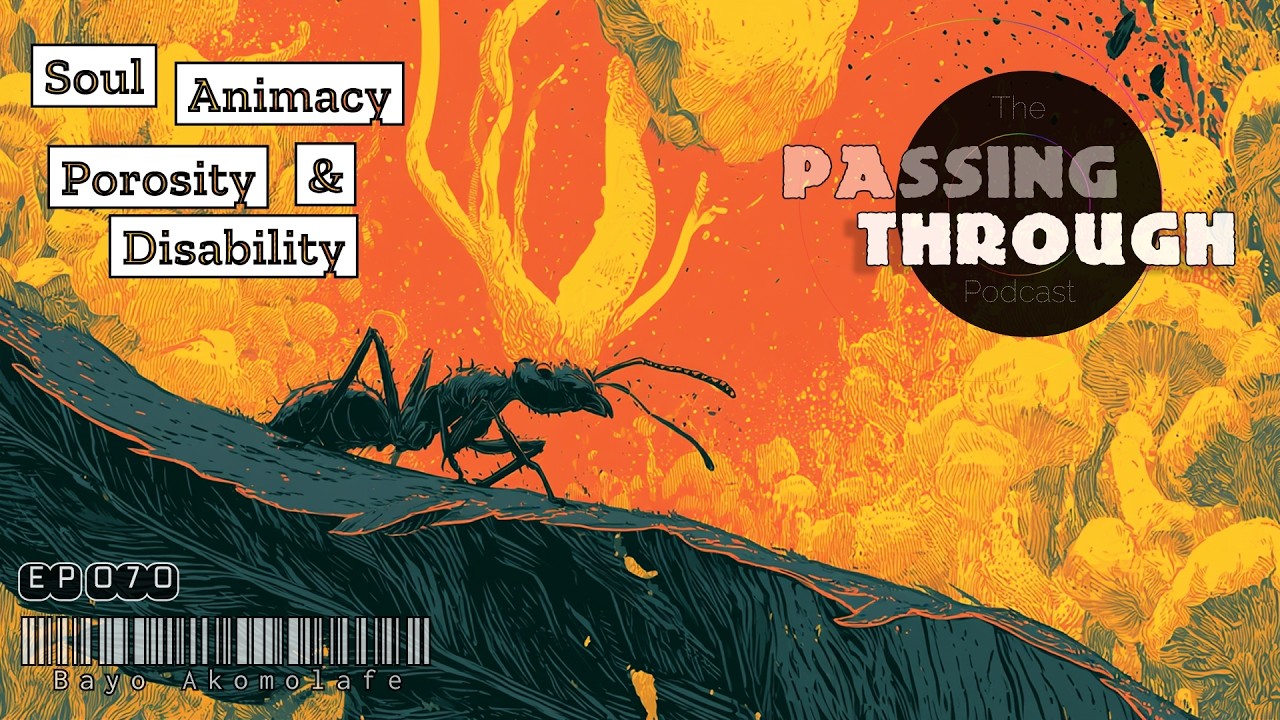
Bayo Akomolafe
Listen
This week Dr. Báyò Akómoláfé is passing through!
Báyo is an author, educator, thinker, philosopher, poet, father, and all-around incredibly kind, soulful, and inspiring human being. It was an honor to speak with him and I think you're going to enjoy this episode.
We speak about the disgusting and the monstrous, Báyo's first encounter with psychedelics, the soul, disability, human porosity, animism, meeting the climate crises without trying to "fix" it, and a bunch more.
You can find Báyo on his website:
https://www.bayoakomolafe.net
on one of his many podcasts, or in his essays, articles, and books.
Links
Transcript
I've been thinking about souls as eruptive events, not stable aspects of ourselves, not a stable core within my flesh, not me molecularly, not me within, but an ecology, a soulscape, that the soul is not you. The soul is what gets in the way of you. The soul is an exquisite misalignment of bodies. The soul is the queering of bodies. The soul is how species leap. Welcome back to the Passing Through Podcast. I'm going to do something a little bit different during this introduction, and I'm just going to speak from the hip. It's something I used to do and stopped. If you listened to the previous few episodes, the introductions are a little bit more polished. I'm reading from a page. I'm trying to organize my thoughts and give you a streamlined, orderly, intelligible piece of content that you could consume, which would prepare you to listen to the episode that you're about to hear. And taking inspiration from this conversation, I realized that I am going to refrain from doing that from now on. It was something I was experimenting with, and I think it taught me a couple of things. I think maybe it's good to have a few things written down that I could read so that I don't forget. Quick reminders, little bullet points. But to have a whole scripted introduction, for me personally, doesn't leave me much wiggle room for creativity, for thinking on the fly, for things to emerge. And what I'm more interested in these days seems to be emergent processes, emergent phenomenon. And so what you're going to get now is just what you used to get with this show, which is me thinking in the present, relaying what's happening in my mind. Whatever's passing through, whatever synapses are firing, I am vibrating that out into the microphone, into your ears. So I hope it resonates, and if it doesn't, bear with me and wait patiently for the coming interview. It's going to be a good one. And part of me wants to continue building a little bit of suspense and tell you where I am. Because after all, this podcast is called The Passing Through Podcast, and I am passing through interesting places right now. But one of the things that happens to be passing through is the sun at this moment. It is about to be swallowed by what I think is the ocean. It could be a sea. I'm somewhere in France in Basque country. And I haven't looked at a map. As we know, Americans are notoriously poor at geography. So the sun is setting as we speak, and I would really like to go catch it. I am just going to cut straight to the point and introduce the wonderful, the lovely, the incredible, Dr. Bayo Akumalafe. He is a man that needs no introduction. Many of you probably know who he is, and if you don't, this will be a delightful treat for you. Because you are about to hear one of the world's most intriguing thinkers. One of the most poetic, captivating, engaging speakers that I've ever heard. I was honored to speak with him because there are many words that can be used to describe Bayo. He's a visionary. He's a luminary. He is an educator. He is a founder. He is a pioneer. But these aren't the things that strike me most about Bayo. In giving him this introduction, I would like to speak from my heart and mirror back what I felt in being in his presence and speaking with him. He is a man of formidable intellect. I was intimidated to speak to him. And you could hear a little bit of that in the interview for sure. But his demeanor, his calm, his poise, his levity, his lightness, his humor put me at ease. And I really enjoyed speaking with him. It's so rare to find someone that has all of those qualities. Plus kindness, gratitude, humility, a sense of care and presence and soulfulness. This is the word that comes through to me. There is a certain soulfulness to Bayo that really I loved. And in this episode, you're going to hear us talk about the monstrous, the disgusting. What the purpose of those things are. We're going to talk about bodies from a morphological perspective. We're going to talk about ayahuasca and Bayo's first psychedelic experience. We're going to talk about animism, spirits, spirit possession, disability, approaching the climate crisis and other crises that we face. Not with this imperative to fix and control and organize and order and make intelligible and contain. But from a place of grief, fugitivity, courage, sitting with uncomfortable feelings and seeing what there is to learn there. Seeing what can emerge if we approach things differently. And we talk about a whole bunch of other things too. He shares a couple of great stories. And I think you're going to really love everything. And I don't want to continue speaking because I can see the light is getting low. If you want to learn more about Bayo, you can find him in a few places. You can find his books. You can find him on the internet at BayoAkumulafay.net. And you can also find him on the intranet. If you want to connect with him psychedelically, he's out there waiting for you. So as always, I'll end this introduction by saying be good to one another. And I'll be back next week. I hope you enjoy this episode. BayoAkumulafay.net. BayoAkumulafay.net. So BayoAkumulafay.net. Welcome to the Passing Through Podcast. So good to be here, brother. You are one of the most captivating, engaging, insightful, thoughtful, mind-bending, poetic speakers and weaver of words that I know. So it is a delight and an honor to have you here. And I am trying very hard to contain my nervous excitement to speak with you. I praise. In the words of the great Nicholas Cage, I praise. Thank you, brother. Thank you. I'm grateful. So leading up to this interview, I was devouring your content. I was listening to podcasts and reading things. And I was trying to prepare as best as I could to be a good host and to ask you good questions. And in the process, I sort of realized that doing so is an attempt by me to kind of conform to modernity's expectations, to be prepared, to have a sense of certainty, to have a sense of direction and all of these things. And I started to feel like, oh, no, this is kind of the opposite of maybe what I should be doing. And maybe I should just throw myself into the whims of the fates here and be at the mercy of the muse and see where it takes us. So I'm kind of going to abandon my approach here. I do have all the questions that I could ask you, but I would rather just go on some adventure and take down the mantle of the host and just see where we go. If you'd be interested in going on this journey with me. I am. Let's do it. Okay. So I would like to start by doing a little bit of channeling the trickster and not talking about the epistemological or the ontological, but the scatological. And go in and talk about something that I think people don't like to talk so much about, you know, gore, feces, excrement, urine, farts, all of these kind of things. Because we often say that the eyes are the window of the soul. But I think maybe public restrooms might be the window of the soul for modernity. Because these are places that we go in quiet desperation and maybe sometimes not so quiet. But it's a weird liminal space when you're in a public restroom. And it's where we're at the mercy of our biology. We're at the mercy of the movement of our bowels. And it's kind of compromising. There's a lot of associations about going to the bathroom. We don't like to talk about it. We like to hide it away. We like to sit in a comfortable seat in a sanitized room and flush it away and not think about it. And I think that this might be illuminating. There might be some wisdom here. And I was wondering what your thoughts are on this. If there's any credibility or any validity in this line of thinking. Well, for some reason, my mind is taken to King Midas and his catastrophe of rendering everything golden and comely. And how comeliness and beauty could constitute a trap. Right? I've told the story of James Cameron commissioning a professor, an ethnomusicologist, to create the soundtrack for his first Avatar movie. And I forget her name. I really just stopped saying I forget her name. Just get her name if I'm going to keep on telling the story. She is commissioned to make alien music. And by alien, Cameron meant something that no one has heard before. I need a soundtrack for Pandora. Right? I need a soundtrack for that. And she went around the world and she collected sound. And she put it together. And she got James Cameron to sit to listen to it. James Cameron raised his head and said, I'm sorry, I cannot take this. It's too alien. It was noise to him. It was noise to him. And so he rejected it and went for the old trumpet sounds that you now hear. It's a soundtrack on Avatar. Right? The familiar sounds. It would sell faster. The ears are entrained to that kind of music. And I raised this up because I'm thinking about, like I said, how comeliness, how beauty, how attractiveness, how rhythm, how music can form some kind of a sensorial prison. And you name these matters of disgust and how our bodies spill away from comeliness. And that reminds me of all the ways, all the practices that we are engaged in to keep together, to keep our bodies together, to keep ourselves together. All the plastic epistemologies that are involved in keeping us presentable, legible. So in a sense, brother, I think we often speak about hiding in the dark or hiding something in the dark. I wonder what hiding in the light entails. Maybe hiding in the dark is obscuring appearance. But hiding in the light is cutting us off from our becoming. That the light is the paradigm of being and comeliness and presentability. And modernity is invested in legibility and categoricity. And so it must render these other morphological matters distant. It must make them distant from us. It must make our toilets not extensions of our bodily, creaturely productiveness, but waste product. It teaches us to see our bodies as isolated within ecology instead of ecology in its secretions. So instead of a biopolitics, we see an autonomous subject. And then we are constantly sniffing out beauty, geometric appropriateness, comeliness, attractiveness, celebrity. Maybe something about these moments teach us to meet these disgusting aspects of ourselves, because disgust is the harbinger of new worlds. Thank you. Thank you. I love that, because there was a question that I had, not that I can see, but that I remember, about this overlap between the disgusting and the monstrous. And I wonder what that is. Are those separate things, or would you say that they are the same? I think the monster's vocation is to disrupt the forms that we are used to. It's to critique. The monster is a critique of comeliness, of form. The monster evokes disgust, right? And disgust is a form of worship. By worship, and you were going to say something? Yeah, I was going to say, can you expand on that a bit? I was going to. I wasn't going to leave you hanging. But it's largely speculative for me. It almost feels like those stories, those Greek stories, those ideas of disgust, of gods birthed from other gods and tearing out of their skins. A goddess coming out of Zeus's head. And a mother whose belly is holding space for a life form gestating within it. And then the nausea that proceeds from the act of gestation and pregnancy. One might say, one might start to say, one might start to say that when we come to the edge of a paradigm, we are compelled to offer disgust or the vomit or detritus. We're compelled to leave a part of the other ones. We're compelled to leave a part of our bodies almost as a token of our inadequacy for that moment. It's like, here's a part of me. Of course, we don't usually see it that way. It's unpleasant. It's unpleasant. But there's something about disgust that feels generous to me. And I'm associating disgust with not just, but the physicality of it, the nausea and vomiting that comes from it. I know ayahuasca ceremonies. It's like you're meeting this grandmother figure and you purge. There's a purge. There's a purging. There's a taking away of something. It's like almost sacrificial. I wonder what disgust is doing, not just evolutionary, but mythopoetically, right? Architecturally, fugitively. What is it playing with? What are bodies doing when we yield in that way? Beautiful. And you read my mind a bit there. As you were speaking, I was thinking of ayahuasca and how there is this purging. And we leave this as almost an offering to whatever powers and entities are going to perform a visitation on us. Yeah. And actually, you, correct me if I'm wrong, but you have some experience with this, with ayahuasca. I just had one for the first time on February 8th in Brazil. My first. Is it something you would want to talk about? Or is it something? Yeah, yeah. It's all right. I won't be able to give language to all of it. There's a part of it that I'm protecting. It's almost like I don't want to sully the experience with words. But I can share, and I've started to share with people about this event and how it thwarted my expectations. And it met me at my deepest place. Yeah. You want me to go into it and say more about it? That's right. It starts with the soul. I've been thinking about souls as eruptive events, not stable aspects of ourselves, not a stable core within my flesh. Not me molecularly, not me within, but an ecology, a soulscape. The soul is not you. The soul is what gets in the way of you. Right? Like the soul is an exquisite misalignment of bodies. The soul is the queering of bodies. The soul is how species leap. That modernity is the tragedy of being born human and dying human within a stable category of thought. But the soul is that which thwarts the body and renders it permeable for other kinds of experimentation, other kinds of inquiries. For instance, the Orpheocodicep unilateralis, the fungus that infects the ant, renders the ant no longer ant, but a fungal ant of some kind, which biologists call a zombie ant. The ant is not just ant now, it's fungus and ant. I think that's the soul. I think the soul is part of our jungle, our ecology that is constantly tugging on the sleeves. If I were to identify our soul, if I were to settle for the idea that the soul is within, I would name our viruses. Notice I used a possessive our. It's not our viruses any more than it's our agency. It's that I am those viruses. I'm a federation of those viruses. Well, I'm getting ahead of myself. I love to talk about these things. But the soul is where I started from. Something very powerful happened to me last year. And I needed to meet the thing that now sat in the place of agency where I had previously installed puritanical notions of myself. I had imagined myself pure and above the fray. And then this thing happened to me in a very material sense. And I lost my bearing. And I needed to hold the fragments of my being in a way. And then this offer came. And I realized that I had been postponing this for too long and I needed to take it up. Have ayahuasca. I was told to set my intentions. Get your intentions straight. I was a bit suspicious about that framing. I don't quite agree with the idea of setting intentions and all of that. I felt that intentions might get in the way. But I understood the need for clarity, which is what people go into these things for, I suppose. And so I said, I want to meet a soul. I want to meet a soul. I want to meet the landscape that is now entraining me in new directions. And I did. I really think that I did. Or rather, it met me. I thought I was asking it to introduce itself to me. It was the other way. It was asking me to introduce myself to it. But not with words. Not like, hello, how are you? What's your name? It asked me to introduce myself by entering me. I had a very profound experience of feeling like I was possessed by something else. That my body was strange to itself. That everything around me was surprising. And I've never been intoxicated in my life. I've never had anything near intoxicating. I've never been beside myself. Turns out my deepest medicine wasn't some trauma or some childhood experience. It was just the idea of sitting outside of my mind, which is an incredibly busy place. To just stay outside of it and watch something else use my body. And that happened. And I'm not going to go into too much detail except to say that at some point in the beginning of this experience, I heard myself say literally, and I say I heard myself say because it didn't feel like I was moving my lips. I heard myself say, among other things, like I'm a snake, I'm a beast. I heard myself say, I am me, but I'm not me. And then it doesn't feel like words I would put down on paper. That feels bland and ordinary to say. It feels too new agey for me to write with due respect to new age folks. But that's not something I would write. But that's exactly what I said. And then I also heard myself say, you're trying to run away. Yeah, there are many things that happened, brother, but I feel like I was taking over in the same way the dyceps takes over an ant. And I was, I thought I would see a soul or see something. Instead, I was seeing through. Something used my eyes to see the world anew. Profound. Thank you for that. I'm just trying to honor it with some silence. Yeah, I love that. That's beautiful. Thank you for sharing. And it reminds me of some things that I've read in your work about the porosity of the human, about how our bodies do not begin and end at the boundary of our skin. And that's something that I've always believed and I've always felt because I didn't have a name for this all my life, only recently, that this is animism. This is this awareness of how we are these porous things. And I think when you are describing a psychedelic experience like that, to me, the heart of the psychedelic experience is that sense of being taken over, of surrendering what's normal or what you have agency or control over. And entering into relationship or dialogue with something that is more than or other than human. And what you're describing here sounds a lot like that. And it really resonates with me. And what fascinates me about that is. If medicines like these, if. Because the medicine, we use the word medicine, but what it actually is, is a living entity. You know, it's a plant or a fungus or a fermented beverage. You know, the act of fermentation. I could tell you a five-minute story about drinking a 40-year-old port wine here in Porto and what this was like to me from an animist perspective. So, like, I see these things as alive. And when we ingest them, when we put what's outside inside, an interesting thing happens. And we get access to these kinds of experiences. But I wonder, these living things that are all around us, do we need to ingest them in order to have them enter us? I feel like the answer is no. But it opens up a very interesting, strange world where suddenly there are a sea of entities all around us constantly. Like a chorus of calls that we don't hear, but sometimes we may feel or we may understand in a different way. You know, we might call this spirit possession. We might call this something else. But I think modernity likes to classify these types of things as superstition or, like, savage thinking. Or that this is, of course, this cannot be the case because we are our citadels. We are these little contained things where the things don't enter. I am me. But as you said, I am me and I am not me. So, yeah, I wonder what your thoughts on all of this stuff are. I consider myself a rigorous thinker. My proclivities do not wade in the direction of fanciful, whimsical stuff. I like to, as much as I seek flight, I also seek depth and robustness. But what happened to me was energetically compelling. It was very compelling. Prior to that, people that work with me and have heard me had a joke. They said that if I ever take ayahuasca, it's unlikely that you would ever take it, Bayo. But if you ever do take it, you become normal. Right? And their implication, of course, was obvious that I was already not normal. Right? And so a negative would cancel out the negative and then I would become normal. So I would agree with you that to ingest it is not necessary in order to participate. We're already participating in fluid, promiscuous fields of possibility. We are already there. Some bodies more than other bodies, I guess. But the point, the question that I really want to ask is, who's the we that needs to ingest or doesn't need to ingest? I think it's a matter of enlistment. Some particularities might be characterized by people who never need to ingest. While others can be characterized by other specificities, can be characterized by people who ingest and will never be able to participate in the way that I participated in my own ayahuasca experience. You know, there are people in that home that needed to wait 30 minutes. After ingesting the black fluid, which felt like a Socratic poison to me. And I first looked at it in the cup that it was. It felt like death. It felt like I was given death. I was out in 10 minutes. I was knocked out. And I thought I was going to be able to resist it because I've never really been intoxicated before. Never been in any form of ecstatic. But that wouldn't be true. I've never been any kind of psychedelic or hallucinogenic induced ecstasy. But I have experienced that in homeopathic doses with writing or with a thought or with music. I'm transported and spirited away. So, yes, brother, I think what you speak to is a grace that is profound. A grace that isn't scarce. A grace that inhabits, proliferates, unsettles white settlement and modernity. A grace that is already here. If only we knew how. And the word isn't a what, but a how. How to posture ourselves differently. To listen to its ever-growing music. Yes. And my next obvious question is going to be how. How do we do that from a practical sense? Because I think this is one of the most important things that we do as a people. Is getting back in dialogue with these things that we have kind of collectively eradicated. We have pretended that, you know, we've relegated them to some other place of lesser existence or non-existence. So how do we practically get back in conversation with these things? How do we listen to the stories that they have to tell and capture the learnings and collaborate with them again? From a practical sense, do you have a sense of how we can do that? I think it involves some kind of fugitivity. I think it involves courage. I think it involves the geophilosophy of disability. Let me explain what I mean. I'm trying to suggest that a knot tied on a piece of string cannot unravel itself. It requires what you might think of as outside help to unravel it. I think we need a spirit in a way. A mass disabling event. I tether my analysis to the histories of loss and captivity, the transatlantic slave trade. Those 11 million bodies that were spirited away and put into boats. Taken across to Brazil, to the Caribbean, to the Americas in general. And something about their spirit in a way allowed them to inhabit and proliferate technologies which were like laboratories of world-building. Our lovelace, a Trini, a Trini novelist, calls this bacchanal aesthetics. Right? That right there in the midst of captivity, there was an opening of some kind. An invitation to tinker with, an experiment with, to make sanctuary with. So I think, brother, that a lot of what we want to start to do, not even start to do, a lot of what we want to really intensify is making sanctuary as a parapolitical project. Politics is about visibility and legibility. Parapolitics is dedicated to the unruly, the not yet seen, the monstrous, the furtive, the fugitive, the illegible, the rhizomatic, the mycorrhizal. Right? It's dedicated to stuff that doesn't have, it's dedicated to decay. And all the ways that art comes into play here are, of course, beautiful reflections that I can get into. But the idea is that the world creates systems. And those systems create order. And they create imperatives and algorithms. But they also create these unanticipated things that Deleuze, Brian Masumi, Aaron Manning call minor gestures. Right? I think of them as weird fidelities. I'll explain. In every commitment, if you stretch commitment to its extreme limit, you have created a counterforce. A counterforce emerges in it. Think about if you could build a perfect surveillance utopian society. Something coming from within the conditions of that perfection will mean its rapid end or its eventual foreclosure. It's like its contradiction. We give birth to our own contradiction by just existing in a particular way. That's like a minor gesture. I feel that if politics could attend to minor gestures, could make art with it, our subjectivities would change slowly. I don't know if you've heard me speak about Deligny. Deligny was, Fernand Deligny was a French author, special educator, visionary thinker, autistic. He lived just during the Second World War and, of course, to September 18, 1996. He died on my birthday. I wasn't born in 1996, but I was born September 18. During the war, he was French. He, in the Vichy regime, Nazi-occupied France, they often threw autistic children in the asylum because they were not worth being human. They were treated as less than. Deligny basically played his pipe and opened the gates effectively, mythically. And parents brought their children to Deligny, who started a renegade camp somewhere in a place in the rustic region of France called Cervaine. And the parents brought their children to him, not to heal, because he explicitly stated that he wasn't going to heal them, not to recuperate them. They were non-speaking autistic children. He said, I'm not going to try and help them. They need to help us. Maybe language and expressibility is getting in the way of seeing differently what Aaron Mannum might call autistic perception. Maybe the world, which he speaks of as profuse, you know, filled with other life forms. Maybe if I could get around language or get to the side of it, I can experience this. And so he had associates working with him and nobody was to speak in that camp. Language, no. And sometimes the kids would take plates and throw on the ground or they would just wander off into the mountainous region. They were not to be controlled. Deligny asked his associates to follow them, to map them, to trace their wanderings. So he called them wandering lines. Beautiful stuff that they created. Thousands of pages. Thousands of pages. My point here is one of those kids would walk around in circles like my own autistic son. Would walk around in circles, just go around. They found, brother, that he was listening to underground water. That our neurotypical sensibilities could not pick up. He was listening to underground water. He was attuned to it. He could feel its sloshiness. I think that is a parapolitics. It's not trying to heal. It has no guarantees. In fact, Deligny called this experiment tentative. And I'm not, my French isn't good. My French is less than not good. It's non-existent. But the word is tentative. There was a tentativity to what he was doing. It wasn't supposed to heal or arrive at some place. It was supposed to just make space for this emergence. And yes, that's how I want to answer the question. That this involves art. This involves disability. I feel disability, when we release it from the explanatory constraints, seeing it as pathology, then we're able to see that a lot of what we carry as capacity, carry as privilege, is actually getting in the way of our becoming transmutated into something different. Hmm. Yeah, thank you for that story and for sharing that. I love the imagery. I love everything about that. And I think there's deep truth and wisdom in it. What it stirs in me is something that I heard you say in one of the podcasts I was listening to, where you said you have. You take issue with trying to fix the environment. Like we're going to fix the climate crisis and all of this stuff instead of letting it be and holding space and maybe embracing disability or helplessness or sitting with the despair and the discomfort. And it made me, when I was listening to you say that, it made me have a thought and see things in a way that I never had before. Because right now, my partner and I, we are facilitators in training for an emergent process. It's a community building method developed by M. Scott Peck in the 80s. And essentially what you do is you sit in a circle with a bunch of strangers and you, you're quiet. And what you're doing is a kind of self-shamanism where you're sitting with yourself and you're feeling what's happening without words. And it's very strange. When I do this, I often feel like I'm in some kind of dense, emotional, multicolor jungle somewhere, just hunting these fugitive feelings. Because I think one of the consequences of modernity is we're often very divorced from our feelings, especially if they're grievous feelings or painful feelings or uncomfortable feelings or disabling feelings. Because, you know, we have to be productive. We have to be useful. And to sit in that circle and pursue the things that are not useful and find them and give them voice. So the point is you sit in the circle, you find what this thing is. Usually it tells you through your body, not through your mind. And then once you understand what its story is and what it's trying to say, you verbalize it to release it so that others can witness it and others can see it. And in doing so, the others see themselves, or at least I do when I'm in these circles and someone shares a deep pain or shame or fear. And I say, I have that same fear. And it made me, this is a long, I'm going in a long circle to respond to you here. But it made me realize that when I think of the climate crisis, and I think of a lot of the crises that we face as part of these myriad crises that we are in, I always have a sense of we need to do something. There's an urgency there. And when you said this of what if we just hold space for these things, we don't try to fix it. It made me realize that that's the same thing that I'm doing in these circles. We're not trying to fix anything. We are seeing what's there and sitting with it and it hurts and people are crying. People are weeping sometimes and not just one person. I might be crying because you're crying. And it's very powerful and very, it makes community. It builds solidarity. It builds compassion, empathy, understanding, connection. And the barriers between me and the other dissolve. And so it made me see the climate crisis in this way where I go, wait a minute, maybe I've been thinking about this all wrong. And I need to apply these community building techniques to these larger crises and just be with them. Listen to the earth crying. Hold it. Share its sorrow because we are extensions of the earth, right? We are that sorrow manifest. So, yeah. I don't know if there's a question in here that I'm asking. I'm just kind of reflecting things back that you're activating in me and maybe expressing some gratitude at having helped me see certain things in different ways, which is a gift. So thank you. Thank you, brother. Thank you. Yes, I think we are definitely more than the categories that we've been stuffed into. And we need a vocation. I don't know if you've heard about this University of New Zealand. You know, this is one of my favorite stories to tell about a catastrophe that happened 42,000 years ago. I've told this story many times. It's called Adam's Transitional Geomagnetic Event or something like that, in which there was a polar shift 42,000 years ago. And they could detect this time based upon a triangulation of methods, but a reading of the tree rings, the rings of a kauri tree, K-A-U-R-I. And he could read it. And this one was 42,000 years ago. And something desperately severe happened. And it led to a breach of life. And Neanderthals had to go underground. Protohuman populations had to go underground. And at least in one estimation, in one hypothesis, this led to the springing up of art, cave art, in caves around the world. It was this catastrophe, this terrible thing that drove them underground. I've often wondered to myself about solutions and resolutions, how they enact a certain kind of politics, and how they reinforce positionality. Like, here's a solution. Fix it. There's something that keeps us going around in circles with a solutionism that isn't alive to the ways that our bodies are never fixed or stable. So, they made art underground, brother, 42,000 years ago. That wasn't a solution to the crisis. It was a making of a new God. It was basically birthing and midwifing a new God, a new intensity. And to birth a new God is to be birthed in a moment, in the same moment. So, maybe by placing their red ochre hands on the cave walls, they were able to perceive the world differently and sense the world. It was an infrapolitics of some kind, but also a parapolitics. Maybe it was more than just solution. Maybe climate change or whatever you want to call it. Maybe it's inviting more than a solution. Maybe it's inviting a shape shift. There's a beautiful metaphor I've heard you use on that topic about the caterpillar turning into the butterfly. I remember that. About how the caterpillar doesn't know how to turn into the butterfly. Oh, yeah, yeah, yeah. I like that one. Yeah. So, that reminds me of this. And I think there's truth in there. And I know we're running up against time here. And you have to go. And I would love to keep this conversation going for probably three hours. But we can get on again. We can get on again. Okay. Yeah, that would be lovely. And I just wanted to give you the chance at the end here to tell people where they could find you, what you're working on, any news you want to share before we close out. Well, I'm working on my new book. It's called An Ocean of Milk, A Parable of Love in Three Numbers. And it's playful and it's mythopoetic. Mythopoic. It is bacchanal. It is fugitive. It's about a Yoruba god who is about to embark on the most significant journey of his life. Which is across the Atlantic. But first, to conduct a ritual that will prepare him for that journey. And this is how I tell the story of Eshu. Entering into the Hindu mythology of Samudra Mantan. And becoming a major character in that story. Yeah. And I'm very touched and excited to be writing this at this moment. Other than that, you can catch me on the intranet. Which is psychedelically, if you want to. Or poetically. It's not the intranet. It's the intranet. Yeah. You can catch me there. There you go. Okay. I hope to catch up soon. And I'm looking forward to checking out the book. And yeah. Thank you for your time today. Thank you very much, brother. Thank you. Thank you.
Comments